

UITS’ Matt Stoner Selected as AI Fellow
The university’s Office of Responsible Artificial Intelligence selected Matt for its AI Fellows Program, recognizing his extensive experience and outreach in Artificial Intelligence.
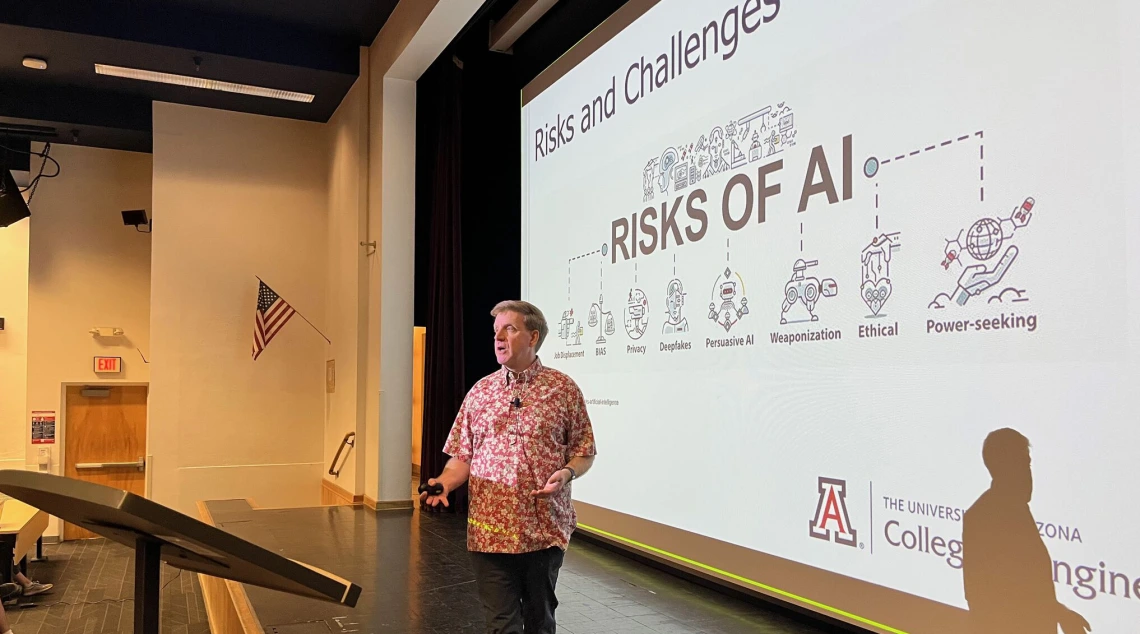
With the rapid growth of artificial intelligence, the University of Arizona needs to responsibly adopt and govern AI in practice. The Office of Responsible AI (ORAI) sought out faculty and staff leaders who understand AI’s implications for their areas of work and are motivated to help shape guidance for the university.
Potential University of Arizona AI Fellows applied in spring 2026 and were selected at the end of July, including UITS senior information systems manager Matt Stoner.
Matt brings a combination of technical expertise and practical AI experience to the program. In his primary job duties with the Andrew Weil Center for Integrative Medicine and other Health Sciences units, he helps his team and other UITS colleagues understand how AI can improve the software development process. He also advises the Weil Center and other university business and academic partners on AI initiatives, helping them identify potential use cases, assess risks, and address barriers to adoption as they consider how using AI can support their work.
AI and Teaching
Matt is also an adjunct instructor in the College of Engineering, where he developed and regularly teaches CE301, Technical Communication. As he prepares his lesson plans, he uses AI tools. He also weaves in the pros and cons of AI into his lessons for students—how it can be a tool to assist them, leveraging its strong suits, and where its weaknesses are that they should avoid. It has become such an important topic for students that he has also been invited for the past two years to lecture on the pros and cons of AI to ENGR102 students.
He has seen the necessity firsthand in the classroom. Since the 2024-25 school year, Matt has noticed more 19-year-old students turning in assigned sample emails and memos in “corporate speak,” which they were not yet fluent in, along with other signs of AI use. For example, in one assignment a student was asked to write a memo to “CEO Morgan Church” of “Blue Steel Construction,” which veered into discussing church structures. The student didn’t proofread or edit before submitting it. Matt said, “I didn’t even need an AI detector for that. Even after all the lectures and all the coverage in my course, he still did it and got caught.”
Students using AI to complete assignments will be an ongoing challenge. Matt says, “We know they’re going to do it.” So, he took on a passion project developing two instructional applications with activities that resist completion by AI and require students to use and develop their own critical thinking skills.
The first application is Makau (Hawaiian for fishhook), which allows students to practice written communication as a tool through intentional skill development. One of Matt’s favorite activities is what he calls a “forensic crime scene” for writing. Students are given documents to evaluate, and they need to find the writing issues in them, such as grammar or tone. Matt explains, “I'm no longer focusing on the final deliverable. I'm trying to get them to evaluate what is good and what is wrong.”
Instead of having peers evaluate each other’s papers, Matt uses AI to generate documents for them to evaluate. He says, “My mind can't work to write wrong, so creating activities and worksheets with grammar mistakes was really hard.” But he can instruct the AI to include exactly the kinds of errors he wants them to look for.
His course attracts STEM majors from across the university, so he also makes his assignment documents domain-specific. “An electrical engineer gets an electrical engineering example; a software engineer gets a software engineering example.”
The whole purpose is to give them skills in proofreading. “I'm trying to develop their critical reasoning and judgment skills so that if an AI spits out garbage, they can actually identify it instead of just copying and pasting it.”
The second application is Walaʻau (Hawaiian for to speak or converse), a public speaking app that provides a private space for students to practice and be coached to improve clarity, confidence, and delivery. Similar to the critical reading activity in Makau, Wala’au includes Insight Watch, a public speaking critique activity.
Students watch a TED Talk and evaluate it. When Matt originally asked for a memo critiquing the speaker's physical and nonverbal delivery, he would get back a verbose summary of the talk from AI with very little critical analysis of the speaker. So, he changed the presentation of the assignment to one AI can’t try to do for them. Now, at various random points in the video, the player stops and it asks the student to describe what’s happening at that point and to assign ratings.
After over 30 years of coding experience, Matt let an AI coding platform take the lead in writing the applications. “I had really moved more into managerial roles in IT and less into coding,” he explained. It takes a lot of time to keep up with all the new languages coming out. “Now with AI, I can do projects again, and I'm not focused on lines of code. I'm focused on the user experience and understanding the backend and knowing what is possible. Then I'm able to create these things with the benefit of these AI coding platforms.”
About the AI Fellows Program
ORAI initiated the University of Arizona AI Fellows Program in spring to begin Fall 2026. Fellows are named for one year, with the option to continue for a second consecutive year.
They intend for AI Fellows to serve as “connectors, conveners, and thought partners, helping translate the University’s AI strategy into meaningful engagement. across research, teaching, and operational contexts.” They will not serve in a technical AI developer role, but rather help shape how the University of Arizona responsibly adopts and governs AI in practice.
The AI Fellows’ leadership role is defined as:
- A human-centered strategist assessing AI’s local implications
- A community connector surfacing needs and risks
- An insight catalyst informing institutional planning
Matt’s own goals as an AI Fellow include:
- Deepening the consulting relationships he has already begun in Health Sciences and turning one or two of them into working collaborations.
- Building a working understanding of where AI fits in STEM education delivery at the university by engaging peers in the cohort and bringing it back to his own teaching and to colleagues in the College of Engineering.
- Bringing everything he learns through the fellowship back into his team and into UITS and the College of Engineering.
You can see the full list of 2026-27 AI Fellows, as well as other AI leaders chosen for ORAI initiatives.
Matt has already been a popular presenter on AI around campus. This summer, just before the start of the fall 2026 semester, he was asked to present at two faculty retreats and to speak to all the engineering department heads and deans. The Fellowship will only broaden his outreach on campus. He is excited by the opportunity to help educate, advise and discuss AI with more members of the campus community. “It's an honor and a privilege, and I'm looking forward to having these conversations within UITS as well.”